Showing posts with label Rio de Janeiro. Show all posts

Thursday, March 10, 2011

Gringo During Carnaval Photos

Rio Maracatu bloco in Ipanema

The front of the procession
The King and Queen, the best dancers, right in front of the drummers
The percussionists. Every type of person was a part of the bloco, each had a role
And then the giant beer can, or 'electric can,' that had the singers and amps


Meanwhile, across town, a bigger party was brewing...

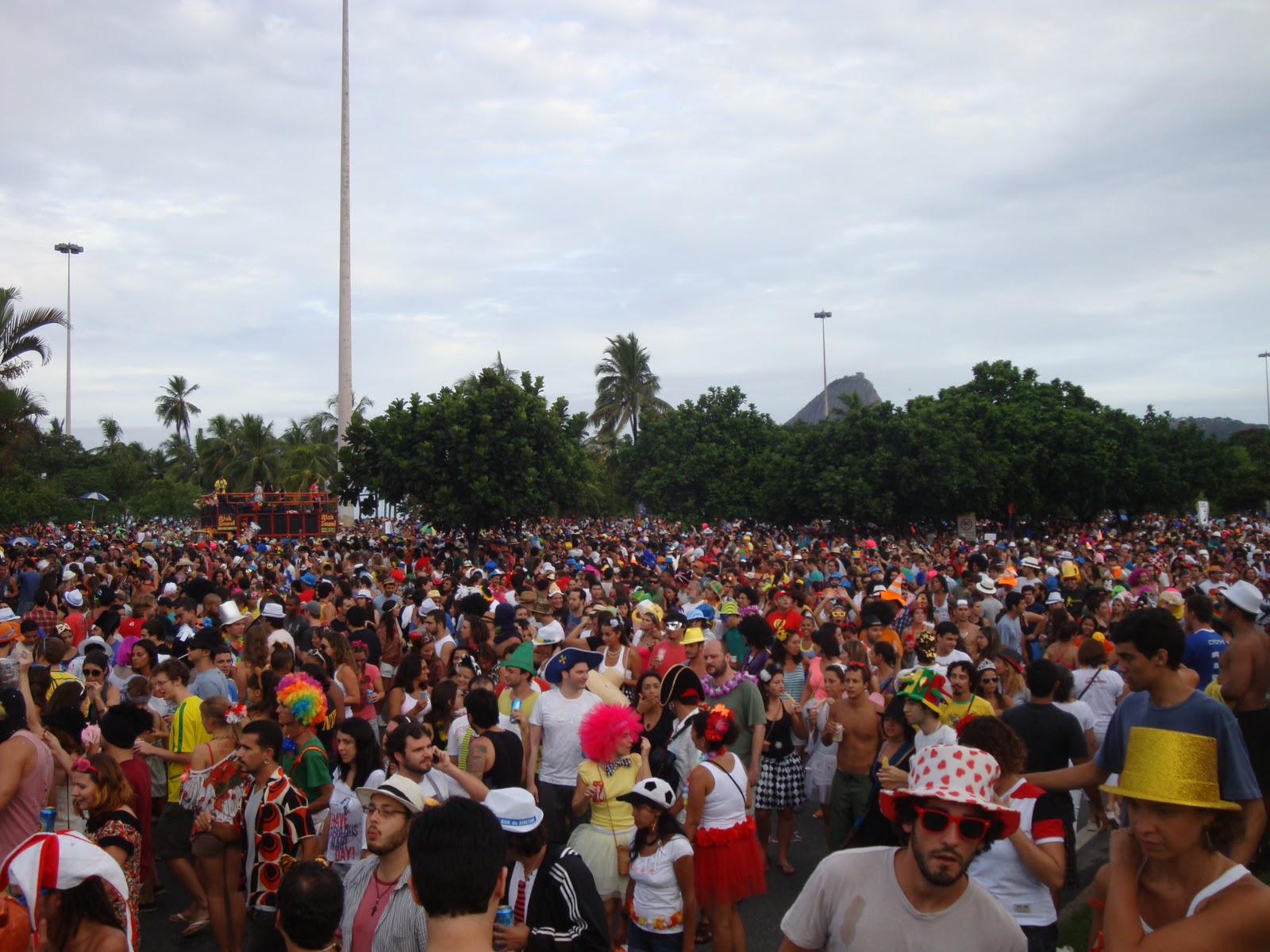
Only a fraction of the crowd

The truck blasted the beats, with the drummers in front

Thousands of people were everywhere
There were a lot of creative costumes

Tuesday, March 8, 2011

The World's Biggest Shitshow

When it's calm

I went, as did a friend of mine, through the "OMG carnaval is awesome--No it is stupid and I hate it--Ok no it's really quite nice" cycle in less than twelve hours today, so I think it merits a few reflections.

As I have experienced it so far, and this has only been for about a day, carnaval in Rio is a chance for everyone to be and do everything they aren't and can't. For men to dress as women, the rich to act poor, for the poor to act rich, and for the extremely poor it offers an opportunity to pickpocket more easily. Also, the vendors jack up the beer prices.

It is basically a physical manifestation in song, dance, and public gatherings of the oh-so-Brazilian attitude of not caring about anything. And it is wonderful if you can get into the vibe, and if you like samba, huge drunken crowds, and crazy costumes. Seriously, its like the Halloween parade 24/7 for a week up in here.

The not giving a crap attitude really comes out, as everything can and will happen. A group of drummers had amassed a huge crowd in a local park, some dancing (I tried), most simply standing around shooting the shit until dawn just because it is carnaval. Taking an evening walk among them I was intentionally swerved into by a bus, saw simultaneous ER discharges fight each other, was subject to a drive-by with cans of shaving cream, and saw an old guy do a very vulgar axé dance.

The same attitude that gives you license to do whatever also is very accepting and welcoming, unlike anything I've encountered before. Standing around in a group of strangers is awkward enough in Brooklyn, Paris, Montreal or Berlin, but in Rio its different. No one cares!

My friend imagined thousands of live chickens kept in the back
During the daytime things can be little calmer, at first glance. People haven't had their naps yet, so are on the first drunk of the day. I went to a bloco (street samba party) that played samba covers of Beatles songs. It was their first year, and they were pretty good. There were babies, thugs, puking girls, hippies, old people, and everyone "all together, right now, over me." I also was near what must have been the world's largest KFC restaurant. -->

I wonder if I've been completely desensitized or what but all that, all this of my first day of carnaval in Rio, has been underwhelming. Don't know if I should blame Iguazu falls, video games, people or myself for that, but hey, here's to the next few days' revindication!

Monday, March 7, 2011

Back in Rio

Conquered Iguazu waterfalls
Hey all!

I've been MIA, traveling around southern Brazil and a little of Argentina. I'll have posts for different parts of that adventure written up over the next week if I can.

I just got back to Rio today, the day after Carnaval officially started. You can tell its partytime as soon as you step off the plane. People with funny hats drink beers while waiting for those little airport golf carts, and every non-essential business is shut down and boarded up. Blocos, or large drunken street parties, happen everywhere all the time. I'll stay away from the 8AM ones and try to be good about updating here for y'all.

Feliz Carnaval!

Thursday, February 3, 2011

Wednesday, February 2, 2011

Real Rio in a photo

A lot of the real Rio de Janeiro most gringos don't see appears in this photo

Thursday, January 20, 2011

The Electric Coconut

Copacabana on a normal weekday
Taking cover from the rain under a barraca, one of those stands on the beach that sells everything, I felt a tingling on the back of my arm. "Ok here it comes," I thought, "my first stress-induced heart attack." My South American friends say I fit the stereotype of a New Yorker, hypocondriatic and prone to complaints (prices, rain, people, etc). I think the latter part is from my French side.

Anyway the tingling continued down to my fingers and up to my shoulder. I moved my arm a little and it suddenly went away. Well-versed in the scientific method, I returned my arm to the original spot and the tingling buzzed back across my flesh. I turned around, saw some coconuts on a shelf next to me, and thought I was crazy.

Crazy because I was being mildly electrocuted by coconuts.

My friend didn't believe me, but I have some experience with being electrocuted by strange things (computers, people, stoves) so I had to electrocute him, with the coconuts, to demonstrate. Standard beach occurrence.

The beaches are the reason Rio exists. The city would be nothing without them, and they are the center of daytime recreation and activities. "Oh, what will you do today?" is a normal weekend question in any city across the world, perhaps met with answers of reading, walking, museums, shows, cultural things, etc. Here, there is one answer: Beach. This has implications for culture and education we can get into another time.

Surfing fail
The attraction of the beach isn't necessarily the water, which is notoriously dangerous and often dirty. The beaches of Ipanema and Copacabana have had hundreds of tons of sand dumped onto them to make them wider, and this has messed up the sea's natural coastal currents.

The lifeguard system is top-notch and responds extremely quickly to any emergency. My friend's failed first surfing attempt, seen to the left, was quickly saved, and there are helicopters always in the air, never more than 5 minutes away, that can swoop in and pick up a distressed newbie.

So the beach isn't about the water; its about the sights. Rio's beaches and really quite beautiful, and while backed by hundreds of apartment buildings, on either side they are flanked by famous mountains and hills, and have several pristine islands offshore.

But again, many people don't care much for that either. What they go to the beach for is a central part of carioca mentality, what drives much of their everyday lives; to see and especially to be seen.

I'd be lying if I said that's not partially why I go myself. I spend most of my time there eating/drinking coconuts, watching the sea. However I actually enjoy swimming around, something many Brazilians seem unable to do. But they are rather good at doing nothing and posing for the perfect tan.

The beaches have quite a colorful cast of characters, and many of them actually make their living there. These are the Camelôs, the dudes who pack around drinks and snacks for us lazy beach folk to overpay for. After renting an umbrella or some chairs, you head down towards the water and set up camp where you think the people are most attractive. If you want something, you watch for the Camelôs.

There are the dirty-beach-mate guys, who lug around two large kegs with spigots, serving what is widely known as the best mate (a kind of tea) in town. There are the regular dudes, who pull or carry coolers with water, beer or mate, maybe ice-cream sometimes too. The guys with the worst job in the world are the ones who carry around a tiny stove to cook cheese sticks. Imagine open-fire cooking in 40 degree heat, and knowing that your customers will get sick from the rotten shit you sell them.

Ipanema at dusk
But it all gets better when the famous acai guy comes around. With his megaphone, he sounds like he should work for radio. "acai acaiii! gelado e saboroso! pontificoso!" I obviously can't type out what he sounds like, but imagine the announcer guys for TV pay-per-view events, in portuguese, and you get the idea.

My second favorite is the abacaxi guy, who many people rightly dislike. He carries around a tray of cut-up pineapples, yelling "abacaxi! aaabacaxi!" But then he goes silent for a while and that's when you need to watch out. He sneaks up on people sleeping or not paying attention and yells "ABACAXI!!!", freaking them out and selling a few pineapples to their laughing beach neighbors.

Overall, yeah, the beach is great. But it really can get boring after a few hours, and after a few days you find yourself wishing to actually do something. This is one of my greatest problems in Rio; if you don't absolutely love samba and doing nothing (on the beach, for example), then can be hard to live here, which I am. But for vacation, nothing's better!

Tuesday, January 11, 2011

Reveillon

Copacabana beach, pre-fireworks, 2 million people
Yeah, New Year's was a while ago, wasn't it? Kinda feels like...last year. And for me in many ways it was, as I have had to learn a new way of living since then. One that doesn't take for granted the most simple of things many of us carry with us every day and wholly rely on.

But before we get to that, a few words on Brazilian New Year, or Reveillon. The name itself sounds to me like a pagan ceremony to awaken an ancient sea-beast like a kraken or something, and indeed there is an idea similar to that behind it.

So basically there are remnants of African religions in Brazil, Rio especially, like Macumba (of which I am terrified) and Candomble. Spooky voodoo/wichcraft shit to my gingo sensibilities. Wiki says, Macumba "is secretly practiced all over the world where there are Brazilian communities. Many Brazilians continue to practice their traditional religions (Christianity, Judaism, etc) but also practice Macumba secretly, usually at night or the weekends." They kill chickens and dance around and use special herbs and become possessed.

Iemanja
Anyway so Candomble is more like a real religion with priests and temples and whatnot. One of its goddesses, Iemanjá, is the protector of the ocean and closely associated with Rio. Kinda like a patron saint. This informs many traditions, practiced all around Brazil, that people perform on New Year's eve to please Iemanjá so she might bring them luck and fortune. Off the top of my head these are:

1) Wearing white. This rule is far more strict than wearing green on St. Patrick's day and is more about symbolic purity than anything else.

2) Throwing shit into the ocean. Iemanjá, being a woman, likes flowers. She likes other "objects of female vanity" as well, however toxic for the waters.


3) Floating candles. Little boats with offerings and candles, floated out to sea. Neat.

4) Eating grapes whole. Not sure what the deal is with this one, but they say you're supposed to do it and make a wish for each one you swallow. Could pose a health risk.

5) Jumping over incoming waves 7 times. My friend told me to do this with no explanation so I just did it.

6) Wearing certain color underwear. Yeah, apparently white is for luck, red for love, yellow for money, green for something else, probably health, and other things people wish for in the new year.

So that's all nice, but what most people go for is the fireworks and massive party. I got to Copacabana with some friends about 5 hours early, encountered a mostly empty beach, drunk people, and some sweet airplanes, then shacked up in a nearby apartment to load up. At around 9PM we headed to the beach. The streets were packed, busses and taxis whizzing people to their destinations, revelers crowding the sidewalks and singing, gringos awkwardly dressed in white trying to make their way to the beach. We found a good spot to set up camp next to a bunch of passed out fat people who made holes in the sand to pee in.

This story should be prefaced with a note that two years ago I had reveillon in another part of Brazil and it was a blast. I expected as much and more from Rio. As with many such expectations of the city, they where not totally fulfilled. In any case when the fireworks started we were blown away. Best fireworks ever. 20-minute show from 5-6 synchronized barges off shore, massive finale, lots of colors and sparkling. I wish I could remember more of it, but everyone said it was great and my video (almost 1,200 views!) proves as much:


Yeah! Woo! 2011! Time for drinks and doing traditional Brazilian things, like making out. I looked around and realized I was in a proverbial desert, surrounded by gringas not privy to the Brazilian way and couples already way into it. Hmm...the RedBull jamming hard in my brain, I said, 'Let's go swimming!' Not the best idea.

Imagine 2 million people on a beach, drinking. Where do they go to the bathroom? It was relatively easy for me, as I had to just saunter in and go, but the girls had less options. My suggestion to go swimming was for them a chance to relieve themselves, and the drinks worked well to help us forget that we were walking into a sea of frothy, salty urine. I was up to my knees and happy, totally not wearing clothes appropriate for the water, bringing in the new year with cheer and good will.

Until disaster struck. At least it didn't rain!

I had given all my pockets' content to a friend to hold while I waded in. I forgot to safeguard the most important thing, what I cannot live without. My glasses. A wave came out of nowhere, hit me in the back and sent me tumbling. Adenir told me these are called 'jaca' waves, alligator waves that snatch things away, but I'm pretty sure he made that up. Underwater, my hand immediately went to my face to discover my loss. Upon emerging from the break, I notified the girls, who were pointedly disinterested and unsympathetic. Unfriend!

Despair and aguish rolled over me harder than any wave. The loss of my glasses rendered me functionally blind, unable to see detail a meter past my face. Imagine wearing a scuba mask greased with a centimeter of Vaseline in the visor, all the time. Night=ruined.

pew pew pew! I don't have any pictures of what happened after.
Or was it? I thought to myself, "well, pretty much the worst thing of 2011 already happened, so it can only get better! Reveillon in Brazil is no time to be emo!" I set out to party my way deep into the the night, which I did, leading my friends along the path to fun. At points I was the most festive, dancing and singing and running about.

At around 4, once we had our fair share of avoiding people having sex on the beach, we decided to head back. We went to the metro, me leading the way since no one else knew. At the nearest station, my friends said that about 10,000 people were lining up to get in. It looked like a giant snake to me. "Let's walk home!"

And we did, about 7km through spooky tunnels and empty streets, soaking wet, unable to see, burdening my wonderful friends who took great care of me. I would have been doomed without them, they stuck by me while all others left. Here is their blog.

I got home at 5:45 or so, too tired to take a shower. The next day I put on my prescription sunglasses and have been wearing them ever since. Blessing in disguise? Adenir dubbed me 'BatNestor' in honor of my excursion, but someone else told me a 'batman' is slang for a drug trafficker. So I dunno what he meant, kinda like how an ex-boss of mine recently complemented me as 'energetic.'

Sunday, January 2, 2011

Rio’s ‘Internal Armed Conflict’ and Counter-Insurgency

Lucky you, you get to read my article for the Rio Times before it's published on Tuesday! Enjoy.

*

The end of 2010 was a busy time for Rio. Between Dilma’s election, the discovery of enormous pre-salt oil fields, and preparing for a massive Reveillon, one could almost forget Rio’s most important systemic concern. The favelas remain a central part of the city’s identity and a major source of many of its problems, and accordingly drew a good deal of attention from the U.S.’s Rio de Janeiro Consulate.

Late 2009 saw a flurry of activity in the favelas as the Favela Pacification Program and the UPP finished their first full active year with plans to expand (singling out Complexo de Alemao as the ‘epicenter of the fight’). However, foreshadowing the Navy APCs and marines in Zona Norte a few weeks ago and belying public confidence in the pacification efforts, retired Brazilian Army General Alvaro de Souza Pinheiro said in September 2009 that the Army was fully prepared to “occupy and maintain control of favelas,” given their experience in UN Peacekeeping operations around the world.

Acknowledging the lawlessness of the favelas, Pinherio said the Army is well suited for pacification, as “many officers and units were specifically trained and prepared to undertake operations related to public security and general policing in communities lacking state control.”

Wealth and poverty are not far apart here

It is significant in itself that a former high-ranking military official admits that the favelas, situated inside a megacity of one of the world’s strongest democracies, need a military occupation like those in Haiti or Sierra Leone. He is definitely not the only one to say so behind closed doors.

In November 2009 the Principal Officer of Rio’s U.S. Consulate met with an unnamed source in the International Committee for the Red Cross (ICRC) in Rio. The source explained what he could not disclose publicly because of ‘Brazilian sensitivities;’ that the situation in the favelas as of November 2009 was “for all practical purposes, a full-blown ‘internal armed conflict,’” with all the implications that such a weighty characterization entails.

While not exactly the definition used in the Geneva Conventions, Protocol II, the main features of Rio’s violence closely resemble situations around the world widely recognized as ‘internal armed conflicts.’ These include “organized factions holding the monopoly on violence in their areas while in an open conflict with rival factions or/and state forces, the humanitarian impacts on innocent civilians trapped by violence in favelas dominated by gangs, and the need for ICRC to operate as though in a war zone.”

The Consulate tentatively agreed with the source’s assessment, noting that it describes Rio’s violence better than simple urban crime. To this extent it took special interest in the Favela Pacification Program’s ‘clear and hold’ approach, which “closely resembles U.S. counter-insurgency doctrine in Afghanistan and Iraq, and highlights the extent to which favelas have been outside state authority,” reads a diplomatic cable from November 2009.

Largely a problem Rio created for itself, the favelas present a unique environment of state failure within a successful state, more similar to Fallujah or Marjah than the Ipanema and Copacabana neighborhoods next door.

Rio State Secretary for Public Security Jose Beltrame explained to the U.S. Consulate, “you cannot imagine what government neglect of the favelas have done to this city. It is a failure of public service” that the city is now paying for with blood. Although the beginning phases of the Pacification Program have gone well, it is only the beginning of the fight.

"The cat." Electrical theft is rampant
As with U.S. counter-insurgency doctrine overseas, the ‘center of gravity’ in the favelas is the population. Success wholly depends on winning the ‘hearts and minds’ of the residents, who must be made to trust and depend on the authorities, not an easy task for a government lacking legitimacy as a relative newcomer to the favelas. The crucial task is to deliver the services and benefits promised, which depends on civilian and NGO components of the Pacification Program following through after the UPPs.

Yet as of late 2009, during a visit to the pacified Dona Marta favela, U.S. representatives noted that “police officers are doing everything from assisting residents with requests for utilities to coaching sports. There is no cadre of civilian government and NGO personnel to handle those tasks, nor evidence of systematic programming for additional services.... If such a vacuum persists, it will wear down police capacity and lead to frustration among residents in pacified favelas, threatening the initial gains in those areas.”

The U.S. Consulate fully supported the Pacification Program and was enthusiastic about the results, saying they “could remake the social and economic fabric of Rio de Janeiro.” But however much U.S. support is genuinely humanitarian and good-hearted, there is no denying the enormous economic potential in the favelas.

According to José Luiz Alquéres, the president of Rio’s electric company Light, the economy of Rio de Janeiro could grow by 38 billion Reals (21 billion USD) through increased economic activity and new jobs, and 90 million Reals (45 million USD) in property and service taxes could be raised if the favelas were integrated into the rest of the city. Not a bad deal for the price tag – data from the Rio State Secretariat for Security show operations to pacify and reintegrate favelas would cost from 90 million to 340 million Reals (48 million to 183 million USD).

If Iraq is any example, we should realize that the road to favela pacification will be tough and bloody, but doable. What helped keep Iraq together was a history of strong central government and the promise of massive oil revenues. The favelas are a totally different situation, but if the authorities can coax the residents with commercial and educational opportunities, the hope of a better life, and then actually deliver that promise, perhaps Rio won't remain a city of millionaires surrounded by slums.

Happy New Year, btw.

Sunday, December 26, 2010

Xmas in Brazil

The family I'm staying with is really wonderful. Caring, attentive, loving and happy, when they gather together one can really feel a strong bond beyond reason. The matriarch, a 95-year-old who remains the center of attention, holds together a group of sons and daughters, wives and husbands, and grandchildren, who really enjoy each other's company.

One of my favorite family members is Edson. My first night in Rio, at a rodizio de pizza ('cycle of pizzas'), Edson, also known as Bruce Willis, immediately befriended me although we couldn't understand much of each other's language. At following gatherings I taught him some English, and he taught me that old people can still be cool. 

He doesn't like Christmas that much though. At his mother's 95th birthday some weeks ago after an emotional song and ritual around her, Edson came to me, holding back tears with a cigarette, and said (my translation), "I hate Santa Claus. He's a motherfucker." Elaborating, he explained that 'Papai Noel' makes him spend all kinds of money on presents, while Santa himself spends nothing. "Is that fair? That's not just."

Nevertheless we all enjoyed Christmas. About 16 of us joined together in a small apartment, the boys in the 'back,' a small courtyard/storage area drinking beers, and the women tended to their mother and the food. The radio lost its MPB station so someone turned it to a house/trance station. Being intimately familiar with electronic dance music, I found this very strange and a little inappropriate, but I realized that the majority of them had little or no idea what it was. It was just an exotic beat, "like disco, musica de sapo" as Edson thought. Nearly every old person danced to it at one point or another. After a few beer and laughs, some food and a little rain ("from our Lady and Lord, it purifies the spirit. I have no problem with the rain" said Edson), it was finally midnight and time for presents.

Waiting for presents
I really like giving presents better than receiving them, I have a hard time knowing how to react. I actually didn't expect anything at all, but got a good haul. I'm pretty sure what I gave was well received as well. The core members of the family had a secret santa, 'amigo oculto,' and it was during this that for the first time I saw someone cry with joy after receiving a DVD.

We got home around 2 or 3AM, then played video games. The next morning, Christmas morning, each person got up at his own pace and after more video games we slowly made our way back to the previous night's apartment for a leftover lunch. It was like the party was already over, like Christmas had already passed, and we were just there to finish up the food. Very different from the American tradition, even with all the TV time.


Wednesday, December 22, 2010

Lapa

Lapa in the daytime

There is a neighborhood, next to the center of Rio, called Lapa. I have mentioned it before. It is a neighborhood whose incredibly poorly-translated magazine heralds as a 'center of democracy.' I have had a friend tell me this too, while stumbling around its streets, which I must admit were filled with a fairly diverse group of people.

Lapa is were Rio goes to get drunk as hell on the cheap. There's samba too. Every weekend, Friday especially, a variety of municipally sponsored street vendors open onto the street, spilling their podrãos and drinks into the mouths of the waiting. A tallboy of beer is 2 or 3 reais, and a toxicity-strength caipirinha is about R$4, which my friend thinks should be illegal. There are lots of bars and music venues, but most people just stand around drinking, often well into the daylight hours. If this is the center of Brazilian democracy, then I guess the country is surprisingly well-off despite all its problems, the least of which is a constant hangover.

Recent weekends have seen my repeated appearance there, so it has lost a little of its novelty for me, but is still a solid backup for when other plans fall through. After an interesting day involving mistaking a heavy opioid for asprin and a subsequent attempt to boogieboard, I met up with a Swedish friend and bought beers from a guy with a cooler on a motorcycle, right in front of the cops. It was then that I realized I wasn't in Kansas anymore.

We proceeded though the growing mass of revelers and sambistas to a pool hall where they only had extra-huge and extra-tiny tables for some reason. Stopping at several places on the way and having been overtaken first by the hare-krishna then a whole other bunch of hippies, we lost part of our group so headed to a horrible club where I paid money to listen to music I hate.


I actually really dislike funky, I think it's among the worst music there is. No offense to anyone or anything, but it's stupid, violent and sexist. The dance is stupid too, but kinda sexy when girls know how to do it. Just sayin', and it's not like I think square dancing is any good either.

I don't remember what happened next, but then I was on the beach with a headache and a broken boogieboard and it was afternoon. I'm pretty sure I had avoided calling for Raul. The camelôs had inspired me with a way to get more ESL students; I was to write on a white shirt 'tem ingles aqui' and walk up and down the beach yelling 'Aaaaulas de ingles! Aaaaulas de ingles!' while giving out my business card. I thought it was brilliant, but my friend said I had better shed all sense of shame before trying it.

Looks innocent, doesn't it?

Back in Lapa that night, I learned that prostitution is a legal profession in Brazil. Get this: they have working papers, legal protections, and retirement! They can retire and get a pension! Amazing.

At was turned out to be a nearly gringo-only event, I spoke with a lovely Californian girl who sympathized with the minor culture shock I was describing to her. "You have to be lazy. Force yourself to do nothing," she said. "That's the only way to survive." That's actually pretty true. Coming from a place (NYC) where everyone cares so much about everything they paradoxically go to great pains to show themselves as the opposite, I have been undergoing a shock of sorts here in Brazil where no one cares much about anything, and excel at avoiding responsibility, especially politically or bureaucratically.

When the place filled up and the cariocas began to outnumber the gringos, I was thankful for being able to amuse myself with mild drunkenness while not understanding anything anyone is saying. I've gotten excellent at pretending to understand Portuguese, and I actually spent about five straight hours today doing that with someone I had just met. But if anything, if I fail to learn Portuguese, I will remember Brazil as the place where I learned that it's ok to look at girls' butts, since everyone here does it and for very good reason. Besides, some are so hemispheric you don't have much of a choice.

The next morning I stumbled back into Lapa. Why I was awake, hungry, and not yet sober, back in the place I had been a mere 6 hours before, was beyond me. I think it had something to do with a waterfall. The pee on the streets was still fresh and small groups of people were still drinking...at 8AM, with the sun already beaming down like a thousand lasers from space.

Thursday, December 16, 2010

Interesting!

For all of you noobs out there, here's 60 Minutes on Brazil. Pretty accurate I'd say!

Wednesday, December 8, 2010

Articles

Hey y'all,

Here is an article by a friend of mine about a monthly event we went to in an amazing hostel in the favela, Jazz in the Maze. If you can read Spanish you should check it out! Actually it has nice pictures too so you should just click and see anyway.

And here is an article I wrote for The Rio Times, Rio's only English-language local news source. It goes along well with what I wrote about last time.

Yeah, so...enjoy!

Sunday, December 5, 2010

Life and Violence

Ok so here we go, its been a busy week, Fluminense just won the Brazilian football championship, lots of things have happened and I'm behind on letting y'all know what's what. Let's crack a beer and get to work.

I've been teaching a couple of classes a week now, nothing serious, and I'm not sure the students like me. I talk too much and hate preparing lessons, especially since I'm paid very poorly. But now I started with a private student twice a week who pays three times more and likes to talk; he's a great, a contract lawyer at a downtown bank who's really, really into comics. Not just like "Oh I read graphic novels" or "I know all the names of Spiderman villains" but more like "I have 3,000 X-Men comics and 300 figurines I painted myself."

Lots of Brazilian nerds
Speaking of nerdiness, a few weeks ago I went to the Brazil Game Show, purportedly an exposition highlighting South American video game developers. It was actually completely dominated by Sony, hot dogs, and long lines. Overall it was underwhelming and crowded, and the convention girls were nothing special. They kinda looked depressed.

Kinda like Superman!
Then I went to the beach, swam in dangerous currents and got sunburned. Fortunately this gave me license to chill out only in my underwear at home, who readers who know me well will recognize as my favorite housewear. 

The next day I went up to the Sugarloaf, which is now what I call voluptuous girls as a term of endearment, and that was pretty neat as the first 'touristy' thing I had done really. The approach up the mountain is controlled by the military, and the previous week a gay man was shot by a soldier there (this was during the pride parade) for no reason. But then I saw some small monkeys ('Micu') and forgot about that.

The biggest news is all the violence and police/military operations that climaxed last week. As you probably have heard, the police invaded several slums in the north zone of Rio and will occupy them for some time. However this isn't really what affected or interested people here, and y'all didn't hear about it because of the latest bickering over in Korea.

It's kinda complicated, but partially the conflict is over the UPP, a 'peaceful police force' that was installed in several favelas around Rio. These new units are sent in to live with the locals, show the human and non-murderous side of the police to occupy and secure the slums after the murderous side has cleared out the bad guys. The governor started the UPP program to stop drug trafficking, but the dealers just decentralized and moved to other slums (the favelas are many and enormous. 1 out of 5 residents in the entire state of Rio live in a favela). Many of the gang leaders are in prison, but just give orders and command from there. When they heard that they were going to be transfered to federal prisons out of state, where life for them would suck a lot more and they would lose control of their gangs, they basically ordered their lackeys to start firebombing cars, attacking police posts and causing mayhem.

This is what started a two week orgy of violence and paranoia. Every day more and more reports of attacks on cars, busses and trucks came in, and people started staying in and not going to work. The metro was seen as safe so was crowded over capacity, which I remember sucking exquisitely. 
BOPE being badass
Most people said it was just a matter of time before this happened, as Rio's huge poverty and crime problems need to be tackled before the mega-events of the World Cup and Olympics. So for the next few days there were tons of cops everywhere, helicopters flying low, and other shows of force; down where I and most gringos and rich people live, there wasn't much except a few shootings and arrastaos. But in the north zone the BOPE, police and marines supported by APCs quickly expelled the gangs from several key neighborhoods. Some BOPE members even complained that the dealers weren't putting up enough of a fight.

Obviously a lot of bad guys got away, and they left lots of drugs (3 tons of marijuana and 300 kilos of coke) and guns behind. So where did they go? Probably to Rochina, one of Rio's largest and most famous slums, inconveniently located very close to Leblon and Ipanema, the richest neighborhoods. (Check out this video I took of a bomb scare in Ipanema.) At this point the gangsters are squeezed and trapped, and could get more dangerous. The two main factions, the Red Command and Amigos dos Amigos, are rumored to have formed an alliance against the cops (with whom they themselves had a treaty of sorts with). NEM, the supposed leader of Amigos dos Amigos that rules Rochina, controls the distribution of cooking gas there and buys silence by being a community benefactor and sponsor for the residents. He was involved in a nasty shootout in the Intercontinental Hotel a few months ago that highlighted how the gangs often paid off the police, how some BOPE members might be involved with the Amigos, and how a whole different problem of 'milicias' of ex-cops run extortion rings and protection rackets.

Just this is a tiny fraction of what's happening, it's all pretty confusing, and only the beginning. What is clear is that the government is cracking down hard, and enjoys huge popular support. Police and military convoys get cheered in the streets, not something you would expect from a county with a history of military dictatorship. The people are tired of the gangs and crime and trafficking, and do not mind when innocents die by police bullets. Some think the favelas should just be razed. This raises the very important issue of potential "fascism against the poor," as a friend of mine put it. BOPE shoot first and ask questions later; the people and politicians look the other way because they just want something done.

Wednesday, November 24, 2010

Language Schools

Unrelated picture of some people on Copacabana
Yeah yeah it's been a while since the last update...but exciting things have been happening and I've been really busy! "What?" you ask. "A gringo busy in Rio?" Well yes, very much so. As your mighty powers of observation have undoubtedly informed you, language schools are today's topic of ranting and have been responsible for ruining my sleeping schedule and preventing beer-ing.

Upon arriving in Rio I was determined to find an ESL teaching job, and confident I could do so. This was based mostly on the fact that on the Federal Immigration form they gave us on the plane 'ship' was misspelt as 'shaep.' After just a few days here I felt like I was languishing (which I was definitely not) and set out upon Rio's English schools with a pile of resumes and a naive smile. There is a string of language centers on a street in Ipanema I decided to hit up first, at the same time exploring that pleasant neighborhood where the coconuts are four times more expensive than they should be.

I quickly sensed things were amiss in the local ESL industry. In the first school I visited I was greeted by an attractive young blonde with braces (lots of young adults wear braces here, it's rather disconcerting) wearing an 'I heart English' T-shirt. She smiled coyly and I thought, "Boy, I wanna work here." I politely asked if she, the senora, spoke English. Her eyes glazed over. I mumbled some more Portuguese as she flustered about trying to find a translator. I really wanted to say, "don't you know what your shirt says?" but she was kinda hot so I didn't.

This scene more or less repeated itself in a half dozen different schools. They all had their own proficiency tests and free compositions, grudgingly handed over by employees who spoke little or no English. Many were actually quite rude, sending me out the door as soon as I announced myself. This was quite a shock, as I expected schools to jump on the opportunity to have a CELTA trained native speaker. A pretentious Brit at a British ESL school explained it to me: He said something like, "we don't hire off-the-boat novice English teachers, and other schools won't either since the socialist government will not issue work visas to foreigners when they think Brazilians can do the job."
Another unrelated picture, of Ipanema

Eventually I found a place that would take me. Due to potential legal issues, the most I can say about it is that whoever decorated the interior and its adjacent cafe must have really had a hard-on for vampires. I doubt you could find more pictures of Edward in one place anywhere else in Rio. I started teacher training there every afternoon for 3 hours at the same time I started daily morning Portuguese lessons, and these both conspired to steal away beach time (however, nap time has been preserved for it is sacred), and are leaving me quite tired at the end of the day. But not tired enough to miss out on a music recital of choral students singing Brazilian soap opera theme songs.

In the teacher training there are some great people, new friends and colleagues, and a crazy lady. Girls cry, men are broken, and I show off how totally pro I am at teaching. The Portuguese beginner-level classes feature a Swede, a half-Brazilian/Egyptian from Amsterdam, some Americans who've been here for two years, some hot Germans and French, and an annoying Australian. I passed the training and now am starting teaching soon, tomorrow is my first class, so that's good...but they pay pretty horribly. I really want to find private students and charge them accordingly...know anyone in Rio who wants to learn English real good?

Tuesday, November 16, 2010

Halloween in Brazil

Two weeks late and....quite a bit else.


It was kinda like Rocky Horror, but more gay. Plus they played that same song over and over until we left...good DJ technique!

Lapa, where you can booze in the street while listening to samba.
Just finished a long weekend here, we had Monday off for a federal holiday no one celebrates; the declaration of the Brazilian republic by the military in 1889 or something. The weekend was good, I went to Lapa twice and got drunk on the street, once just for the hell of it and the other time to pregame for the above 'show,' themed after Alice in Wonderland.

During my walks back home (which everyone condemned me for, they say its a dangerous route) I got too see all sorts of street prostitutes waiting on the side of the highway, just like in the movies! Also, just like in the movies, they were all once men! I gave a wide berth, steering between them and the random dudes coking up in the middle of the sidewalk, avoiding the young street kid puking in the dumpsters he was diving into. Nothing I hadn't seen already in Harlem or the lower east side, really.

I have to go to my first Portuguese class now, then teacher training. No time to go to the beach! I'm still as white as an off-the-plane gringo. More words and pictures to come.

Friday, November 12, 2010

Football is Sweat and Flight

Football is huge here, bigger than anything comparable in the U.S., and all the stereotypes about South American football are true. They really do say 'GOOOOOOL!' and they do get into fights frequently. Choosing a local team is a serious consideration, and everyone wants me on their side. Adenir has his own approach. Football pervades every aspect of his life. He wrote a thesis, his 'monogram' as he calls it, unsolicited and by himself on how the public education system, the placement of football fields and the impact of football on society interact. Basically what I understood is that football is both capitalist and communist, whatever that means. Based on this 'monogram' he then produced a book of football poems and songs, the main work entitled "Football is Sweat and Flight." He sang it to me and after I congratulated him on his creativity his daughter said, "only my father writes poem-songs about football," to which Adenir replies, "it is very hard to write about football."

The furthest Adenir has taken the football metaphor is for explaining how he feels about Shakespeare. After lunch today I learned about goiabada, a cheese and guava paste dessert. It's pretty good, but not as good as knowing that the cheese part is called 'Romeo' and the jam 'Juliet.' This was Adenir's cue to clue me into another part of his 'monography,' where he wrote, "Shakespeare, he comes at you like a football, then, he send you away like a football." He gestures a triangle and explains, "You, and the Shakespeare, you take and he take, like in football." [Update: it turns out that's an actual quote more or less from the Comedy of Errors] Thinking about it later that idea actually makes sense in a way, but how he came upon the simile of football to describe the hermeneutics between text, author, and reader baffles me.

I got to see my first match ever last Sunday. I am not a sports fan and find it terribly boring when on the TV, but being at an actual game is surprisingly fun. It was between Vasco da Gama, the 'underdog' team of the poorer classes (which was also the first football club to allow blacks to play) and Fluminense, the current tournament leader and supposedly the 'aristocratic' team. The last time these two teams played, a Vasco fan died and there were riots. I was advised to wear muted colors and avoid raising my hands when near the hardcore fans of either team.

Arriving at the stadium was a little stressful, as there were hundreds of people jammed into a one-way street with cars trying to poke through the crowd. Cops were everywhere, but clearly outnumbered by the hooligans. The crew I arrived with was split between Vasco and Fluminense fans, although of the same family so nothing got rowdy. I went with the Vasco fan all the way around the stadium to the Vasco entrance, where it was markedly less crowded and crazy. Vasco was in 12th place and playing the 1st place team, so nobody expected much.


The game itself was pretty fun, but what was much more entertaining were the fans. They waved giant flags, played samba and team songs in the stands, and chanted insults at the other fans. The chants for both sides were pretty much like 'Ole, ole ole ole, fuck you [other team], fuck you.' They screamed ridiculous insults at the players, gestured what plays they should make, and almost went into a frenzy when Fluminense players started pretending to be injured to waste time. Listening to them, I learned words I'm glad I don't remember lest they slip out at the wrong time. My favorite fan was a little girl with vocabulary of a grizzled old sailor on shore leave.

After the match fans flooded the streets and tension was high. Around 20,000 people were shuffling out of the stadium, most of them drunk. Fluminense won 1-0, but faked lots of injuries, and Vasco had more shots on goal. To diffuse any unruliness were tons and tons of cops, just like in the movies. They had horses, giant nightsticks, and M4 carbines. The people living around the stadium in a near favela-like neighborhood took great advantage of this huge influx of drunken money and tried selling almost anything they had; music, water, drinks, snacks, and probably children if you asked. I didn't. The Vasco fan I was with looked physically defeated, and deflated even more as his uncle (a Fluminense fan) ragged on him the whole way home. I kinda zoned out during that part, so I all remember from the rest of the evening was seeing a paintball arena that also advertised itself as a sex-shop. I'm looking forward to visiting that establishment sometime.

Tuesday, November 9, 2010

Adenir and Education

Waiting for me at the Rio airport was Adenir. He is a wonderful man from Minas Gerais, a rural farm state next to the state of Rio (like New York, Rio de Janeiro is a state and a city). He studied under my grandfather and was his secretary during the 70's or sometime when the military or someone was doing bad deeds or something. Whatever happened, he now worships my grandfather, which of course is good for me; free lunches.

His rural background and affect remain with him, much to the chagrin of his two children, but I find it charming and it has him say all kinds of great things. He once asked me what religion I was while we were examining some of his books. I replied, "a little Quaker, but mostly nothing" (readers of my other writings will know what's up with me and Quakerism) to which Adenir said, "I am, a little, Alfredo!" Alfredo being my grandfather. The next day we were having dinner at a choperia where I learned that "cariocas [people from Rio] are beautiful but problematic" and how quail eggs "are Viagra," and on the way back Adenir states, "Alfredo is like Batman. You know Batman?" I mumble in reply, "euhh, sim?" Adenir beams at me. "Yes. Batman, Robin, and Alfredo." With that I know I'm welcome in his home for at least another week.

On my first day in Rio, the family sat around at lunch and discussed politics. Pretty much everyone I've met doesn't like Dilma, the new president, for various reasons (another classic Adenir moment: "Hey, she is woman, give her a chance. It will. Be. Interesting."); either because she's a hypocrite, or not radical enough, or too communist. Each person at the table had such a different political opinion it was hard to believe they were related. I sat wide-eyed and overwhelmed, trying to drown out the cacophony of unfamiliar sounds (they weren't even words to me at that point) with mouthfuls of cachorro-quente. Once I had eaten everything I had nothing to hide behind so tried to describe the midterm elections in the U.S. Not surprisingly my explanation quickly devolved into me saying 'left, right, and center' over and over until Adenir chimed in cheerfully, "Politics. It is just like football." And with that, discussion was closed.

I love the guy, he really takes good care of me, almost to the point of absurdity. Like holding my shoulder when crossing the street, or directing me around the subway (which has special cars just for women during rush hour) with his hand on my back. On our way to a public school where he teaches he was so absorbed in making sure I got on the train that he fell in the gap between the train and platform. He was fine, thank goodness, and later asked me what it means when the train announcer says "mind the gap." 

Adenir with a student
At his school I got to see what few gringos see; an up-close and intensely personal experience with Rio's public schools. Fabricio, Adenir's son, later told me, "you went to hell and survived!" In retrospect, yes, I have seen hell and it is a classroom filled with screaming favela teens hitting each other, knocking over desks, and repeatedly asking if I am Edward from Twilight or if I know Justin Bieber personally. "This is just our situation," a teacher told me, "we deal with it." 

I was paraded though a series of 'English classes' where I sat in a corner and had half the class huddle around me and the other half completely ignore me and the teacher, who translated for the kids with a massive profanity filter. The boys usually took passing interest, asking me about video games (FYI 'Pikachu' is the same in Portuguese) and action movies, hip-hop and American women. The girls were, for the lack of a better term, what my friend Sam would call 'prostitots,' and would not shut up about how nicely they could cut my hair or how badly they wanted to see New York. The teacher I was with told me, "Brazilian women are very sensual. It is hard to be a gringo man in Brazil." Normally I would have thought she was crazy, but after what I saw in those classrooms I think she might be on to something.

After 5 hours I was definitely ready to go, and as I left with Adenir a girl from one of the classes I visited ran up and put a piece of paper in his pocket. It was for me, and had 'please, write, email soon!' scrawled on it with an Gmail address that weirdly sounded like a New York hospital's name. I told him more or less what happened (we have a pretty big communication gap), how the kids were very talkative but didn't say much, the ridiculous questions, etc, and his answer made me laugh. "You see, here in Gloria neighborhood there are many trees. They talk a lot here because there is a lot of oxygen!" Its all about delivery with him.

Sunday, November 7, 2010

The Trip

I had half a mind to turn around pre-boarding. "What do ya know, I've been put on the international travel blacklist," I could say. Or maybe "my plane had snakes. Supposedly that happens sometimes." I'm glad it didn't, I dislike snakes. Propelled along by months of inertia and talk, I boarded and took my seat. In my notebook under the heading 'BRAZIL' written boldly, intending to mark a departure from all previous notes and ideas, I wrote my first thought upon boarding. It wasn't 'oh boy here is the first day of the rest of my life' or anything soppy like that but rather 'hey, the plane's entertainment system runs on Linux. That's neat.'

Arriving in Houston I was treated to a final dose of Americana. Might as well, I was going to be away for a while. What struck me was that terminals were named after football players and the floors were cleaned with tennis balls stuck on the end of broomsticks [UPDATE: ditto in the Leblon Mall]. Everyone who passed through the airport was, of course, subject to various screenings, searches and intimidating announcements. But perhaps the most effective security apparatus was a bronze statue of H.W. Bush, the airport's namesake, striding confidently into the wind with book in hand and a jacket slung over his shoulder, looking down on us with a stern gaze saying, "don'chu fuck with my airport, terrorist." Under his eyes I felt guilty of something and fidgeted around uncomfortably. Maybe they put those microwave emitters recalled from Afghanistan in there, I dunno. 

A fitful night's sleep filled with reruns of 'The A-Team' and 'Salt,' both of which had errors so egregious I had to fight to not comment to my neighbor about them, was interrupted by arrival in Rio. Leaving the security of the American plane I was immediately awash in a turbulent sea of incomprehensibility. I put my default phrase, "Eu nao entendo Portuguese," on defcon 1 to launch out of my mouth in case anyone tried communication. My defenses were not tested, and I made it through immigration without any problems, putting to rest months of arguing over whether I should have gotten a visa. From there on out, I was winging it. No legal status, no job, no language, and a suitcase filled with wishful thinking (read: free condoms from a thrift shop in Soho). But what I did have was waiting for me in the arrivals area of Rio's delightfully 70's poured-concrete airport.